Copyright Rijana
Conjunctivitis or inflammation of the conjunctiva
What is it?
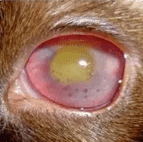
Conjunctivitis is an inflammation of the conjunctiva of the eye. This is the inner lining of the eyelids. In most of our pet species there is also a "third" eyelid to be seen, in the inner corner of both eyes (the "nictitating membrane"). This last one also consists of conjunctiva and therefore also participates in case of inflammation of the conjunctiva.
What do we see?
Characteristics of an inflammation are swelling, redness, warmth and pain. In conjunctivitis the conjunctivae (the conjunctiva therefore) become red, swollen and are sometimes painful or itchy. Often there is a purulent discharge.
Eye discharge.
Sometimes the animals rub their eyes with their paws or rub their head along objects such as a mat for example. If it is a painful inflammation they will squeeze the affected eye completely or partially shut.
How does it arise?
Our skin and therefore also the conjunctivae of the eyes form a natural barrier against invading pathogens such as bacteria and viruses. Germs can end up on the eyes. If the patient has reduced resistance or wounds, they cause problems. The germs get the chance to "take hold" and make the patient sick.
With reduced or altered resistance, reactions of the conjunctiva can also occur due to invasion of pathogens, or sometimes even due to something you are allergic to (pollen, dander, etc.).
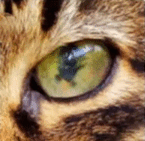
Not every "red" eye is an inflammation!
In conditions that are more serious than a simple conjunctivitis we initially also see conjunctivitis symptoms (swelling, tearing, redness, pain). However, in case of damage to the cornea or even deeper parts of the eye, giving only an ointment or drop is absolutely insufficient.
With glaucoma, a very threatening increased intraocular pressure, the dog will initially only have some red conjunctivae. his is however an emergency!
When to go to the vet?
From the foregoing it is already apparent that actually every abnormality of an eye must be assessed by the veterinarian. It is often very difficult to make the correct diagnosis, and knowledge is needed for this. Some eye diseases start innocently but have a rapid and serious course. Remember that you only have 2 eyes! For you it is important to remember the following points.
· Squeezing shut of an eye
· Rubbing over the eye or rubbing along objects
· Red, swollen conjunctivae
· Blood vessels running over the cornea
· More tears than before
· Purulent eye discharge
· Crusts in the corners of the eyes or on the eyelids
· Thick eyelids
· Haze on the cornea
· Being photophobic
· Reduced vision
· Eyes more bulging than normal
In all these matters you would do well to call the vet. A scratch over the eye or a thorn in the eyeball are emergencies! A decent eye examination includes, in addition to carefully inspecting the eyeball, the eyelids and the inside of the nictitating membrane, also a measurement of tear production (Schirmer Tear Test; with a few simple paper strips) and a fluorescein staining to check for damage to the cornea.
Treatment of conjunctivitis
As already stated, there are several causes for getting conjunctivitis. Most forms can be remedied with either an antibiotic or a combination of an antibiotic with corticosteroids.
These latter medicines may only be administered after a doctor has established by means of fluorescein staining that there is no damage to the cornea.
Almost all eye remedies are available either as ointment or as drops.
In case of extremely purulent eyes these must be cleaned before administration of the medicines, for example with physiological solution.
Ointments are applied by applying a strip of ointment to the eyeball, with the hand holding the tube resting on the patient's head: if it moves suddenly, your hand moves with it, and you do not poke it in the eyeball.
Drops should fall, with the head held up and the lower eyelid pulled open.
If the drop hangs from the spout of the bottle and also touches the eye, the contents of the bottle are contaminated.
Most ointments and drops should be administered as often as possible, but at least 5x a day.
This is because the contact time of the product with the eye is so short. An opened package is usually usable for a month.
The packaging should state how the product should be stored.