Copyright Rijana
Dental Care
The importance of dental care in the (young) dog and cat.
Dental problems are very common in dogs and cats. Research shows that in cats, 29% of all complaints that the veterinarian is confronted with are dental
Problems. In dogs this is slightly higher, namely 31%. In short, almost 1 in 3 animals suffers from its teeth.
In animals older than 3 years this has risen to 85% of dogs and cats. In short, most pets urgently need dental care.
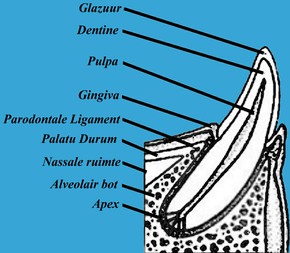
Dental problems in the young dog and cat fall into 2 groups: problems with the elements (= teeth) themselves, or problems with theperiodontium
(this is the gums, the bone and the structures with which the element is anchored). In figure 1 you see a cross-
In this article I only wanted to talk about the cause and consequences of tartar.
Tartar starts with dental plaque that attaches itself in the corner between the skin flap indicated as gingiva (figure) and the enamel of the tooth. Under this
flap food residues etc. remain. From this dental plaque develops.
This dental plaque slowly mineralizes into tartar, and the latter is enemy number 1 of the dentition. As a result of this tartar the skin flap becomes
increasingly loose, so that it eventually no longer sits over the enamel, and part of the root becomes exposed.
This root is many times less hard and strong than the enamel and therefore quickly rots. The gums recede further and further. Loose elements are the result, with eventually loss of an element. There are a number of factors that accelerate the development of dental plaque: Small breeds
(Poodles, yorkshire terrier, Maltese) and dogs with a short muzzle (Pekingese, Shih Tzu etc) have more and earlier problems due to the shape of their muzzle. Abnormal position of elements promotes it.
The amount of minerals in the saliva is genetically determined: more minerals means more plaque. Sweet food promotes tooth decay.
The most important complaints with which the veterinarian is confronted are:
· Persistent bad breath
· Chronic gum inflammation
· Loose elements, tooth loss
· Painful, sensitive oral cavity
· Nasal discharge, sneezing
· Chewing problems
More important, however, are the consequences for the rest of the body and the general health of the
animal. Veterinarians call this the systemic consequences. Through the opening along the tooth neck and
root, all kinds of bacteria can enter the body. As it were, abarrier has disappeared. The consequences
of this are in the diagram below. In all these places bacteria can then get stuck and cause inflammation
In short, regular dental care is of great importance to cure and prevent conditions.
What can you do? Your pet does not have problems yet? Then good and regular brushing is important. With this you remove the plaque and tartar will
develop less quickly. Urge your veterinarian, at least if he does not already do so himself, to inspect the dentition properly at every check. Consult your
veterinarian if you think something is wrong with your pet's teeth.
Your pet already has dental plaque or tartar? Have this professionally cleaned by your veterinarian, it is best to have it polished as well, as your own dentist also does with you after removing tartar. Then again brush regularly and check well.
Furthermore, special chewing strips are also available from the veterinarian. These contain special enzymes that help dissolve plaque.
He also has special kibble that cleans the teeth. Your veterinarian can tell you more about it.
In summary:
So it is not only of the utmost importance for people to keep a healthy and intact dentition. Our pets are also living longer and longer, and therefore have
to get by longer with their teeth.
Be sure to check the growing dog and cat regularly for his/her teeth, not only for the occurrence of tartar, but also for the absence
of elements. Pay attention to whether all teeth, both milk and permanent elements, erupt well and in the right place.
If in doubt, have the veterinarian check it for a moment.