Copyright Rijana
Ear infection
Ear infections often cause problems in dogs and cats. The animals shake their heads, scratch their ears and sometimes whine with pain. The ear itself is dirty
and red. In most cases there is an inflammation of the ear canal. Occasionally we also see a middle ear infection in our pets.
All dog and cat breeds can get an ear infection. Especially dogs with floppy ears such as the Cocker Spaniel and the Golden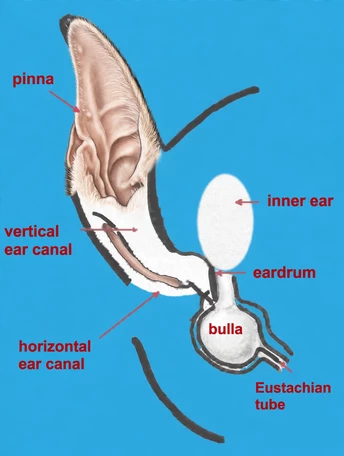 Retriever are sensitive, but also for
example the German Shepherd.In young animals and in cats that spend a lot of time outside, ear
mites are an important cause of ear infections. Ear mites are small white spider-
that live on earwax. In addition, there are bacteria and yeasts that like to live in the ear canal and can cause problems there.
Ear infection can also be part of a skin condition such as atopy (a kind of allergy).
An ear infection is easy to diagnose. The animal holds its head tilted, flaps its ears or scratches
them and sometimes whines with pain. The inside of the pinna is red and dirty and can smell
unpleasant. In case of a middle ear infection, the organ of balance can be affected and then the
complaints are more serious. The animal gets balance disorders, walks in circles or even falls over. In every animal with an ear infection, a good examination is important. The veterinarian will
have to see whether there is an infection with ear mites, an infection of only the ear canal or
whether there is more going on. Sometimes additional examination is necessary. This could be a
culture of the earwax, but also X-
In the case of ear mites you can achieve good results with ear ointment containing a pesticide.
In case of infections with bacteria or yeasts, antibiotic-
If the ear canal is very dirty, we first rinse the ears (under anesthesia). If necessary, in animals
that suffer a lot or have itching, painkillers and suppressive tablets can be given as well.
In case of a middle ear infection, a (long-
with recurring inflammations, which have therefore developed an overgrown ear canal, the entire
ear canal can be surgically removed. The problems are then definitively over, but your animal has
then also become deaf, but with a closed overgrown ear the animal already did not hear much anymore.
In most cases you can treat your animal with ointment. Make sure that there is a little bit of ointment on the outside of the nozzle of the tube. This makes insertion easier. It is important to apply the ointment in the ear canal itself. This means that in a cat you insert the nozzle halfway and in a large dog completely into the ear with the tube held vertically. This treatment must, unless otherwise prescribed, be repeated daily. After 1 week have your animal checked by the veterinarian. Checking the ears is important to see whether the ointment is in the right place and is working well.
In stubborn cases it is wise to regularly clean both ears with ear cleaner. In addition, do not let the dog swim because moist ears are more likely to become inflamed. Never clean the ears with cotton swabs because serious damage to the ear can be caused by this. If the ear infection seems to come back anyway, contact your veterinarian immediately and prevent worse. Annoying chronic ear infections can only develop from insufficiently treated "ordinary" ear infections. However, a chronic inflammation is many times more difficult to cure.