Copyright Rijana
Parasites
Ticks:
A tick (a small blood-
-
Babesiosis:
Babesiosis is a protozoal infection similar to malaria, the tick must have been attached for at least 24 hours to transmit it.
Lyme disease:
Lyme disease or Lyme borreliosis is an infectious condition that you can contract after being bitten by an infected tick. Fortunately, not all ticks are infected,
only 10% of ticks carry a disease-
What are ticks?
Ticks are small spider-
In the Netherlands the "hard tick" Ixodes ricinus occurs. The life cycle of a tick starts as a larva and, through various intermediate stages, ends after 2-
as an adult tick. Ticks are active in the period March to October. They are most active especially in humid weather. In winter they are in a resting period.
Ticks are parasites. They live on blood that they suck from humans and animals. On average 14% of ticks are infected with Lyme.
From a survey by the RIVM in 1994 it appeared that in that year 33,000 Dutch people visited their GP because of a tick bite. Of them 6,500 got Lyme disease.
The diseases:
The best known disease is Lyme disease. This disease can develop in both humans and animals. In cats, a tick bite manifests itself because the tick itself is still
visible or you feel a lump on the cat's skin. The main risk factor for infection is the time the tick spends on the skin.
The tick takes its time to gorge itself with blood. The longer that takes, the greater the chance that you become infected.
Ticks should therefore be removed as quickly as possible. (within 48 hours)
Prevention:
Avoid contact with bushes and tall grass. Especially during risk periods, make sure that all body parts are covered in children, Ticks can crawl inside even
through the smallest openings. Check the skin in the evening after staying in nature for the presence of ticks.
Check your cat regularly when it goes outside, but certainly once every 2 days.
Don't do:
Never use alcohol or a cigarette to anesthetize/remove the tick. In a reaction, the tick may regurgitate the contents of its stomach and that only makes the
chance of disease greater! An anesthetized, or even a dead tick, is no easier to remove than a living specimen.
Also do not use tweezers, because you run the risk that the tick will not come loose completely and the head remains stuck and thus causes infections.
The tick is only in the skin with its head, what you see is only the body.
Fleas in pets:
A common problem in pets is the presence of fleas.
The presence of these small brown, laterally flattened, animals often leads to severe itching and scratching in your pet.
It is not always easy to determine a flea infestation. Especially in densely haired or long-
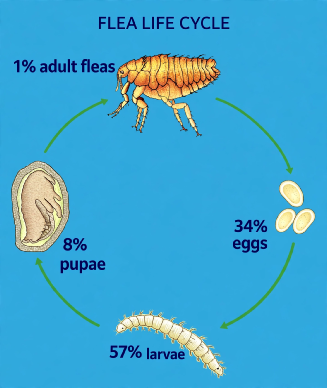
Moreover, only the adult flea lives on your pet, the other stages (egg, larva, pupa) are in the immediate environment; in most cases your house.
The flea you see on your animal is therefore only the tip of the iceberg!!
It is therefore better to look out for the presence of flea droppings: small black-
sand or flea droppings, you can rub such a granule on a wet piece of white paper. In case of flea droppings, the paper turns reddish-
degradation products of the red blood pigment present in it. There are two types of fleas, namely the dog flea and the cat flea.
Of these, the cat flea is by far the most common, also in dogs. In order to reproduce, the flea needs a blood meal.
After this, the flea lays a few dozen to hundreds of eggs, which fall to the ground in the immediate vicinity of your pet (your living room). After 6-
To get blood, the flea bites a small blood vessel and sucks the blood flowing from it. To prevent this blood from clotting immediately, the flea injects a little
saliva into the skin. This saliva contains a protein that inhibits blood clotting. However, some animals show an allergy to flea saliva.
A flea bite then ensures that the animal does not know what to do with the itching for 5-
Dogs then bite open the rear part of their back, often until it bleeds.
Later this part of the back shows bald spots.
Nowadays we can determine with a simple skin test whether your dog is indeed allergic to fleas. In cats, dozens of small bumps and scabs can be felt over the
entire back.The rear part of the back shows bald spots.
The continuous licking and biting of the coat sometimes leads to the formation of hairballs in the stomach and to vomiting and/or weight loss.
These allergy symptoms can be combated quickly and effectively in both dogs and cats. In addition, the fleas must be adequately controlled.
Flea control:
For the control of fleas many means are available to us. Of these, only a few are adequate.
Whatever means you use, you must always follow a 2-
and the other stages in the environment. Fleas in the environment can be controlled with aerosols or pump sprays.
 Choose a product that not only kills the young fleas and larvae, but also prevents the
hatching of eggs. These are the so-
This spray protects for +/-
A completely different way is to give the dog or cat Program pills or paste. Fleas that bite a treated
animal ingest this substance and can no longer reproduce. This greatly reduces contamination of the environment. However, the fleas do not die!! Other means are needed for this. For the control of adult fleas on the animal there are a great many means in circulation.
Whatever you choose, the most important thing is that you use the product regularly to give the fleas
no breathing space.In addition, you must always combine it with a product that tackles the fleas
themselves. In dogs, the spray and drops in the neck (Frontline, Advantage) are easy and effective.
Shampoos and powders only work for a short time and are therefore not so suitable.
In cats you can also use Frontline or Advantage.
Furthermore, tablets (Cyflee) and collars can of course also be used. Bio-
Tapeworms:
In both dogs and cats the most common tapeworm is transmitted by fleas.
Fleas infected with tapeworm larvae are caught and eaten by your pet when grooming its coat.
In the intestine these tapeworm larvae are released again during digestion of the flea and grow here into adult tapeworms.
We find the released segments of these tapeworms, as white pieces the size of rice grains, on the faeces.
The tapeworms can be easily controlled with worm tablets. However, to prevent the tapeworms from returning time and again, the fleas must also be tackled.
Tapeworm control without adequate flea control is therefore not really possible.
When using the worm pill, a kitten is given a pill about every month. In adult animals about 2x per year.
Summary:
If your animal suffers from fleas, tackle it thoroughly. Treat the animal and its environment. Use products that are effective and safe (children). If you can no longer manage, contact your veterinarian.