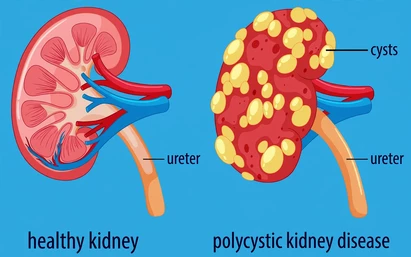
Copyright Rijana
PKD is the abbreviation for Polycystic Kidney Disease.
It is a hereditary condition that occurs in cats.
Cats with PKD have multiple cysts (= fluid-
Both the number of cysts and the size of the cysts will increase as the cat gets older.
These cysts displace the healthy kidney tissue, causing kidney function to decrease.
Eventually, chronic kidney failure will occur.
Often around 6-
Why we test for PKD.
PKD is a dangerous disease.
Because the disease only comes to light after years, it is important to detect the disease at an early stage, so that we do not breed with these PKD-
Cause of PKD:
PKD is caused by a defect in the DNA, which causes a certain protein that is important for proper kidney function to be formed incorrectly.
PKD is inherited dominantly. This means that if one allele PKD1 is present, the disease will manifest. An allele is a carrier of hereditary information.
There are 2 alleles: PKD1 and pkd1.
If a cat has PKD, one or both parents must always have PKD. No PKD cat can be born from two PKD-
What are the symptoms of PKD?
As long as the kidneys are still functioning sufficiently, there will be no complaints.
As soon as kidney function deteriorates and more than 70% of the kidney tissue is affected, the cat will develop symptoms of kidney failure. This can take years.
The symptoms of kidney failure are:
-
-
-
-
-
-
-
-
What is the therapy for PKD
Unfortunately, there is no real therapy to cure the cat. The cysts in the kidneys cannot be removed.
They become larger and larger and cause more and more damage over time.