Copyright Rijana
Hypertrophic cardiomyopathy
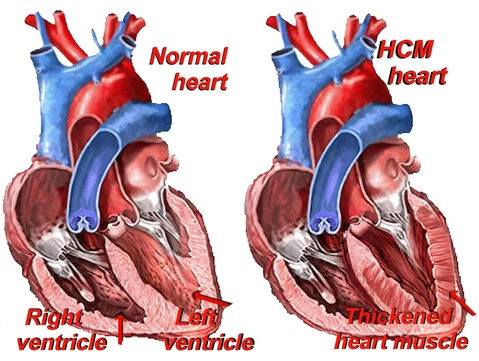
The term hypertrophic cardiomyopathy means 'disease of the heart muscle, in which it (partially or completely) becomes thickened'. HCM is mostly a hereditary form, (autosomal dominant) or arises after other conditions (high blood pressure or other abnormalities).
Both parents do not need to be carriers to be able to transmit this disease, it is sufficient if 1 parent has it.
The chance is then 50% that the kittens also get HCM.
What are the symptoms?
If there are complaints of HCM, these usually consist of reduced endurance, chest pain or the occurrence of cardiac arrhythmias.
After the age of 3 years (in humans approximately at their tenth year) this disease will manifest itself and the symptoms will increase.
In a later stage the cat will have to deal with stress and shortness of breath. The cat then hardly has any appetite causing it to become strongly emaciated.
Especially the too rapid beating of the heart can lead to dizziness, fainting and sometimes to sudden death.
HCM can be established with certainty by means of an ECG or heart tracing. With this one can measure the thickness of the heart wall.
The diagnosis can usually be confirmed by making an echo of the heart.
On this the thickening is generally clearly visible. It can also be checked whether there are problems with pumping the blood into the aorta
(body artery) and whether the heart valves function properly.
When it is then established that the cat has a large heart with an enlarged left atrium one can speak of HCM.
Which treatment?
There is no treatment against HCM.
Medicines can extend life to about the sixth year of life. The medicines can improve heart function and reduce the chance of thrombosis.
In humans at this moment a number of hereditary factors in the DNA (so-
The best known, and for practice at this moment most important, genes are called the myosin binding protein type C (MYBPC3), the beta-
gene (MYH7) and the troponin-
If one of the above symptoms occurs in your cat, consult a veterinarian immediately!