Copyright Rijana

Geriatric syndrome
A symptom (or complex of symptoms) frequently occurring at an advanced age, which has a number of causes (both risk factors and diseases), which along
a usually not yet fully clarified pathway produce the relevant health problem.A non-
Memory disorder, dementia, acute confusion, falling, heart failure, gait/posture disorder, immobility, dizziness, fainting, incontinence, depression, sleep disorder,
malnutrition, loss of self-
Also less frequently occurring symptoms can in a number of cases require an analogous geriatric analysis (e.g. vomiting, swallowing disorders).
Geriatric analysis can also be desired in treatment considerations with regard to a complex clinical picture caused by various diseases and/or dementia.
Introduction
A tilted head posture is a neurological abnormality that occurs quite often in the cat or dog.
The abnormality is actually almost always caused by damage to the balance organ (vestibular system). Because in humans especially strokes manifest
themselves in a hemiplegia, it is often incorrectly concluded that in the cat or dog it is also a matter of such a condition.
Unfortunately this wrong and too gloomy diagnosis is often made in the cat or dog, sometimes with all consequences thereof.
Therefore we would like to inform you about this condition.
Causes
Fortunately, serious conditions that cause a tilted head in the cat or dog occur only rarely. In those serious conditions one can think of:
A disorder in the balance organ. Characteristic here are rhythmic spontaneous eye movements as a result of a disorder of the vestibular nerve, which
connects the inner ear with the brain.
Causes located in the brain.
These are accompanied by diverse slowly developing abnormalities. The rapid eye movements are absent here.
Tumors, brain trauma and brain hemorrhages, all fortunately rare in the cat or dog. Infections of the middle or inner ear, sometimes as a complication of an
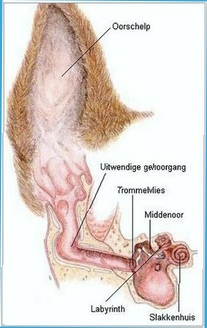
external ear infection. These infections occur somewhat more often. The most common cause of the tilted head posture especially in older dogs is however
the Geriatric vestibular syndrome. The cause of this is still unknown.
Because usually no structural abnormalities are observed in this either, it is also spoken of as an idiopathic (in itself standing) vestibular disorder.
Symptoms of the Geriatric vestibular syndrome:
• A sudden tilted head posture
• Balance disorders
• An uncertain gait when walking and falling over
• Uncontrolled rapid movements of the eyeball (Nystagmus).The pupil of the eye moves from left to right or turns circles.
• Nausea, vomiting and reduced appetite.
• It often occurs at an age of 8 to 12 years or olderDiagnosis
If your cat or dog shows such characteristics, your veterinarian will do an extensive general physical examination.
To be able to exclude as much as possible the other above-
Things eventual neurological symptoms and diseases of the internal auditory canal are looked at.
If the symptoms point to the geriatric vestibular syndrome, additional examination for more certainty, such as
Radiological examination, is usually postponed, because the phenomena of this syndrome will decrease within a few days.
If the symptoms do not improve quickly, further examination is indicated to be able to completely exclude other causes
of the tilted head posture.
Treatment
Treatment is usually not necessary. Without treatment the symptoms will diminish within 2-
Possibly some supportive therapy can be given against the nausea.Most animals learn within 1 to 2 weeks to compensate for the abnormality and can further
lead a normal life. A recurrence of the geriatric vestibular syndrome does not occur often.However, it may be that the cat or dog permanently retains a more
or less tilted head posture. Also the animal may continue to have some trouble with a somewhat uncertain gait when walking.
Warning
The picture at first always seems very serious, especially because we often reflect the diseases of our animals to the conditions in humans, where with this
kind of symptoms we often first think of serious conditions such as brain symptoms caused by an infarction, a hemorrhage.
But such conditions rarely occur in animals. And in certain cases, such as with a tumor, besides the previously described phenomena, other symptoms will often stand out, such as general illness, paralysis of the facial muscles and Horner's syndrome, with the characteristic symptom that one pupil is larger than the other. So before a too gloomy diagnosis is made in case of a tilted head posture, it must first be established that there is no question of the most probable cause thereof, the Geriatric vestibular syndrome.