Copyright Rijana
In the 1930s, the first Colourpoint was created by crossing a white Persian with a Siamese
In the beginning, it was clearly a matter of trial and error; it was not until the 1940s that the matter was finally tackled scientifically, with Siamese being crossed
with Persian Black and Blue. The resulting short-
produce the Colourpoint Persian. They were mated together and back-
Persian Black and Blue to
develop the Persian type, and the cats born from this, crossed back to the Colourpoints, produced an excellent new generation of Colourpoint Persians.
Finally, after ten years of selective breeding, the long noses and large ears of the Siamese had been bred out and the Siamese colour pattern, the blue eyes and the Persian type were definitively established.
From a Colourpoint pair, 100% Colourpoint kittens are born, but to maintain the type, they are crossed with solid-
crossed back to original Colourpoints. When back-
Due to the mixed ancestry, the Persian Colourpoint has become a particularly strong breed and litters of five to six kittens are no exception.
During the Second World War, not much breeding of cats was done in Europe, so there was also a considerable delay in the breeding programme for the
Colourpoints. Due to the delay, a lot of breeding stock was obviously lost. In America, breeders were not affected by the war; they continued their breeding
programme and called their creations Himalayans. Only a few years after the war was the breeding programme resumed in Europe.
Grooming
As with all long-
away under anaesthesia. Despite regular attention, mats sometimes still form, especially when the cat is often outside. Someone with experience can then cut
through them with a special mat splitter instead of cutting them away, so that a bald spot is not immediately created.
Knots are removed with a comb with widely spaced teeth, after which the dead hairs are removed with a regular comb. Finally, the coat is brushed with a
brush made of real hair. Do this daily, so that the coat stays healthy and it becomes a pleasant routine for the cat.
The Colourpoint is essentially a cat of the Persian type -
and the tail. The European, American and British standards are identical.
The coat is long, thick, soft and silky, and stands well away from the body. The ruff is very full and continues down between the front legs.
The body is cobby and low on the legs, deep chest, sturdy over the shoulders and rump, and short and round in between.
A long, slender, Siamese body line is faulty. The legs are short, thick, straight and strong.
The feet are large, round and sturdy, with long tufts of hair between the toes.
The tail is short, very full and carried low. A long or kinked tail is considered a fault.
The head is broad and round, with plenty of space between the ears.
The neck is short and thick, the face nicely round. Nose short and broad, with a distinct stop.
The ears are small, rounded at the tips, tilted forward and not too open at the base. They are set far apart, set low on the head, and are well furnished with long
tufts of hair. The eyes are large, round, brilliant and full and wide-
PERSIAN COLOURPOINT CROSSBREEDS
Crossing with other Persians to improve type resulted in the appearance of other coloured long-
recognition in Europe as varieties of the Persian (Chocolate Tortie and Lilac Cream).
In the United States, however, these are considered crossbreeds (Himalayan Hybrids). They are useful for breeding Himalayans because they carry the
appropriate genes, but cannot be exhibited.
The Colourpoint crossbreeds look like Persians but are usually cheaper.
Who is a colourpoint suitable for?
Someone who loves a striking, elegant cat with a lot of personality. They do need attention — this is not a cat that wants to lie alone on a cushion all day.


COLOURPOINT/TABBYPOINT
EXO/PER n/a/b/c/d/e/f/g/h/j 33
EXO/PER n/a/b/c/d/e/f/g/h/j 21 33
Eye colour:
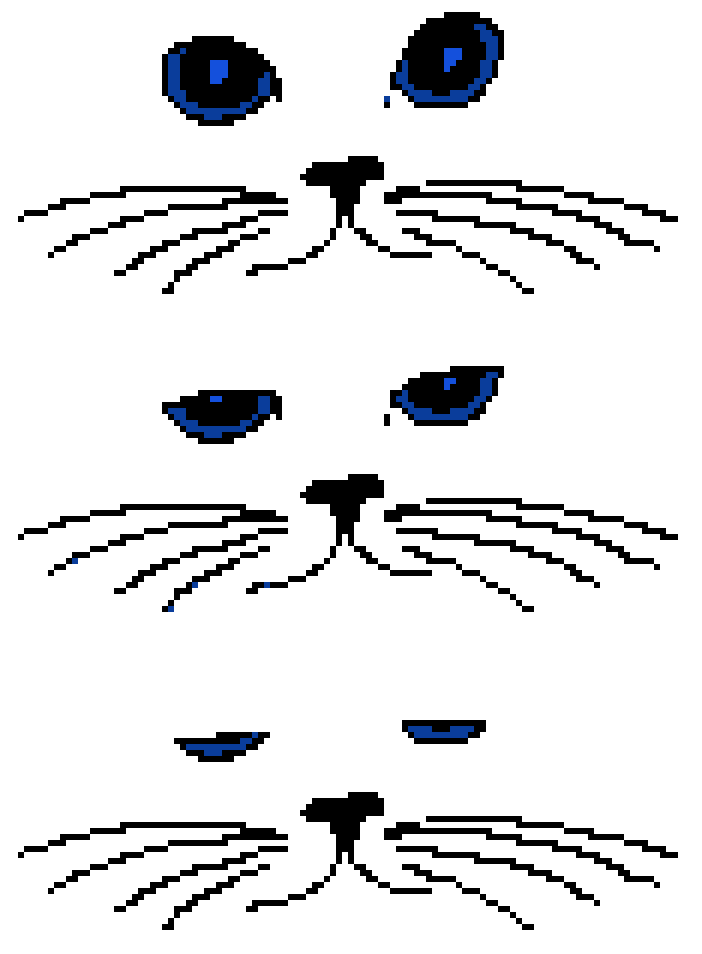
deep blue, and as azure as possible